
“The longer you can look back, the farther you can look forward.”
This statement belongs to the former Prime Minister of the United Kingdom, Winston Churchill, wherein he points to the fact that our knowledge of past events and ancient civilisations helps predict future events and developments. And the best way to learn the past is to peruse it from history books. Generally, when it comes to history books, we think of some boring and cumbersome volumes, which tend to make learning tedious and mundane. However, that is not the case with all history books. There are numerous history books, covering the UAE and world history, which offer an intriguing perspective to analyse the past. In this piece of writing, we, BooksWagon UAE, have presented a thoughtfully curated catalogue of history books that anyone- a scholar, a student, or just a casual history reader, can enjoy. These books are carefully authored by seasoned historians and writers and offer a profound insight into the past. Now, let us dive into the list of some of these interesting history books and assist you in reliving the past with pages of the present.
Sapiens: A Brief History of Humankind
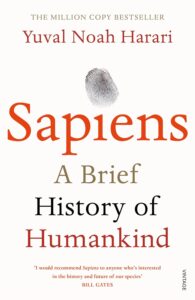
Authored by Yuval Noah Harari, Sapiens presents a thoughtfully illustrated history of humans, covering periods from the Palaeolithic, Mesolithic, and Neolithic ages to the modern era of the 21st century. The book details how humans have evolved throughout history according to their requirements and conditions.
The book begins with the ‘cognitive revolution’, an incident that took place around 70,000 years ago due to certain genetic mutations that changed the wiring of the brains of ‘homo sapiens’. The incident led to the development of primitive methods of communication that enabled ‘homo sapiens’ to live cooperatively.
The next important incident described by the book is the ‘Agricultural Revolution’, a period of ploughing, cultivation, and domestication of animals. This period resulted in an exponential surge in the human population, owing to surplus food production and community living. Author Harari calls this period a fraud, as the era led to the worsening of workload and stress on an individual.
Then the book moves towards the period of early kingdoms and wars. Herein, the author highlights new inventions, new empires, new commerce, and the introduction of a controversial entity – money. By the end of the book, we see a transition towards the modern period, the era of capitalism, colonialism, and the Industrial Revolution. All in all, Sapiens covers the complete history of humanity and can be read by anyone from any part of the world to understand the fundamental events and incidents, which ultimately culminated in our present world.
The Rise and Fall of Ancient Egypt
Thoughtfully articulated by Toby Wilkinson, ‘The Rise and Fall of Ancient Egypt’ covers the history of the unification of Egypt at the beginning of the 3rd millennium BC to its disintegration with the death of Cleopatra in 30 BC. This book offers a comprehensive insight into the history of the early Egyptian empire in a lucid and simple language.
The book begins with the unification of the Nile Valley under the leadership of King Narmer, a period of brutality and grim practices, like human sacrifices, to cement the authority of elites. This is followed by the period of pyramids, physical embodiments of royalty. Next comes the era of civil wars and instability that eventually led to the First Intermediate Period.
Thereafter, the book turns towards the invasions of the Hyksos and their expulsion by the Theban loyalists who reunited the region. Then comes the period of the pharaohs, highlighting certain key figures like Tutankhamen, Akhenaten, Queen Nefertiti, and others.
By the end of the book, we are introduced to the invasion of the Greeks and the Romans under various generals, primarily Julius Caesar and Mark Antony. Overall, ‘The Rise and Fall of Ancient Egypt’ provides readers with a gracefully presented story of the first nation-state of the world, from a period of brutality and subjugation to its decline. It covers incidents of treachery, civil uprisings, political turmoil and wars that eventually shaped ancient Egypt.
A History of the World in 47 Borders

An English journalist and non-fiction author, John Elledge, has written this book to provide us with a brief but necessary understanding of how certain lines and fronts have transformed the world into a place of constant conflicts and an arena of continuous geopolitical tensions.
The book covers the origin of certain international borders, such as the border between Upper Egypt and Lower Egypt, the first recorded man-made border of the world. It also details the Roman border strategies, the disintegration of Charlemagne’s Empire, the division of the world by Portugal and Spain through the Treaty of Tordesillas, the Iron Curtain, and the post-WWI borders, among others.
Overall, ‘A History of the World in 47 Borders’ presents the history in a new perspective – the perspective of maps and lines. Instead of throwing big paragraphs and cumbersome facts, this book bestows readers with an interesting and appealing way of learning and analysing historical events, along with their impacts.
The Fall of the Ottomans
This is a detailed and beautifully illustrated work of the Oxford Historian Eugene Rogan, who chronicles how the Ottoman Empire’s decision to enter the First World War proved to be a fatal mistake for them, ultimately leading to their end. The treatise also explores pre-war scenarios, such as internal instability and the Young Turk Revolution of 1908.
Eugene Rogan profoundly and thoughtfully presents how the Ottomans’ call for Jihad to arouse Muslims of different parts of Europe against Britain, Russia, etc., turned a local squabble into a world war. He describes how Middle Eastern fast-moving fronts were different from the Western Front, generally slow or occasionally static and how early victories of the Ottomans, like the one at Gallipoli, completely shocked the Allied powers.
But as we know how things ended, this Middle Eastern history book also moves towards that very thing by the end, detailing the revival of Allied forces, their attacks on Turks, the humiliating treaties and agreements that followed the war, and post-war atrocities, like the Armenian Genocide. Thus, ‘The Fall of the Ottomans’ is a complete and comprehensive opus of the last days of this great empire.
UAE 101 Stories & Cultural Learnings
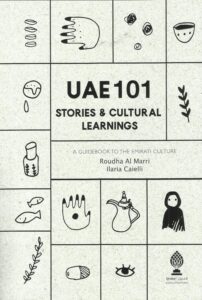
Co-authored by the Emirati writer Roudha Al Marri and the Italian journalist Ilaria Caielli, this is one of the best history books for kids and bestows readers with illustrated 101 stories from all over the world to learn about early civilisations, personalities, and cultures. This is not a regular history book but a beautifully presented historical graphic novel that informs us about the richness of Middle Eastern culture and civilisation in an appealing way.
The book highlights local architecture, cuisines, embroidery, and dresses. It also gives a beautiful articulation of everyday customs, folk arts and traditions, social norms, and the behaviour of people of the UAE. The graphic novel covers dual perspectives, combining local stories and fables with international research and viewpoints.
Inventions & Discoveries – Ancient Civilisations: Knowledge Encyclopaedia for Children
This 32-page children’s history book is an interesting and attractive treatise that provides a brief introduction to numerous discoveries and inventions, along with the personalities associated with them, from all over the world. It is for readers aged 8 to 16 years of age and presents boring historical facts in an alluring way, full of pictures and colours.
It introduces us to technologies and tools like burnt bricks, ploughshares, potteries, and so on. It also has pages that introduce children to famous historical personalities from various fields, like Archimedes of Syracuse, Chanakya of India, Cai Lung of China, and Hero of Alexandria. All in all, this 32-page opus is an intriguing guide to explore famous discoveries and inventions, along with the associated personalities, of the world.
Final Words
History is not just about remembering facts from the past. Rather, it is a thorough-going journey into the era of bygones in order to learn what happened so that we can predict what may happen. If you try to mug up facts and figures of history, you will end up exhausting your mind within an hour. But if you read history through our collection of the best history books, you will actually re-live the past, thus profoundly understanding the what, why, and how of the world. We offer books written by internationally acclaimed authors and award-winning historians who have honed their skills and knowledge through innumerable studies and research. At BooksWagon UAE, you will get all of their books at the most affordable rates with assured quality standards and fast doorstep delivery. So, why wait anymore? Visit bookswagon.ae, order your favourite bestselling history book, and grab the opportunity to dive into the past to learn about your future.
Frequently Asked Questions
Q1) What are the best kids’ history books in the UAE?
Ans) ‘The Who Was? History of the World’ by Paula K. Manzanero and Robert Squier; ‘UAE 101 Stories & Cultural Learnings’ by Roudha Al Marri and Ileria Caieli; ‘What’s Where On Earth? History Atlas’ by Fran Baines; ‘Inventions & Discoveries – Ancient Civilisations’, and others are some of the best history books for kids.
Q2) Where can I buy history books online in the UAE?
Ans) BooksWagon UAE is one of the best online bookstores in the UAE to order books online. Here, you will get all the best-selling history books, either illustrated books for kids or detailed treatises for academicians and scholars. Also, there is the facility of doorstep delivery of books with assured quality standards and reasonable prices.
Q3) Why should we read history books?
Ans) There is a saying that those who do not learn from history are doomed to repeat it. A good history book offers deep insight into past events and the lives of prominent figures of our past. They inform us about the richness of our culture and the extent of our scientific discoveries in the ancient period. History books are not just a collection of facts but a journey into the era of bygone days that teaches us something we, hitherto, didn’t know.